














- New

Estimated dispatch: 30 October – 3 November (3–5 working days after payment)

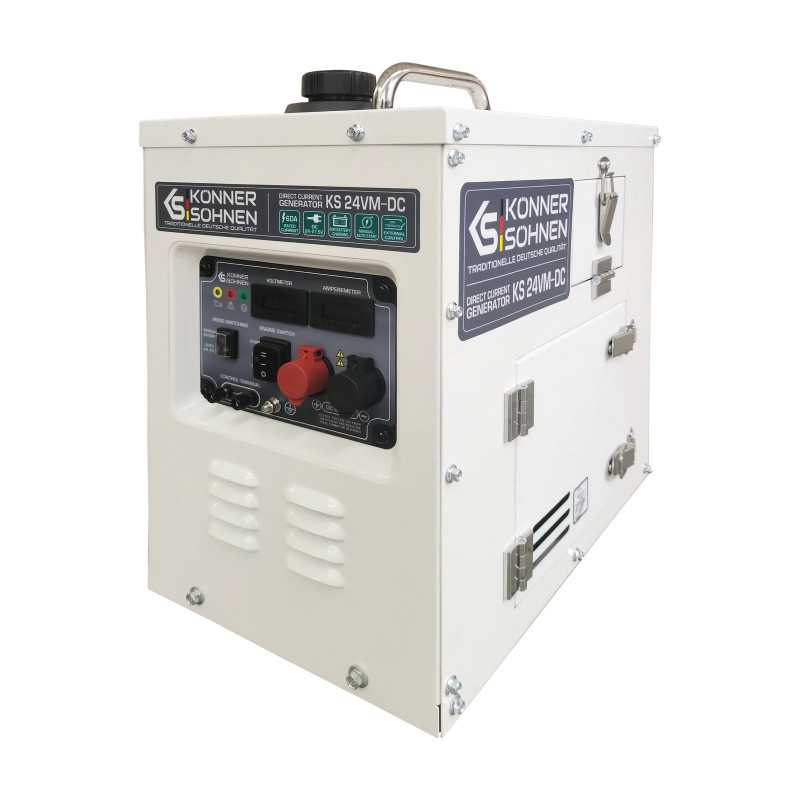
A DC power generator for charging 24–27 V batteries in backup power systems, solar power stations, CCTV systems, security solutions and for maintaining battery charge whilst vehicles are parked.
In AUTO mode, it starts automatically when the battery voltage drops, charges the battery and, once the required parameters are reached, switches to standby mode.
It has a rated power of 1.6 kW, a current of up to 60 A, a noise-reducing metal casing, an LED display, an indication of key parameters, and is compatible with Tandem Power technology for operation in tandem with the KS 3000PS.
 Expert advice
 On-time delivery
 Technical Support
 Secure payment
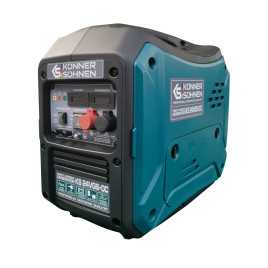
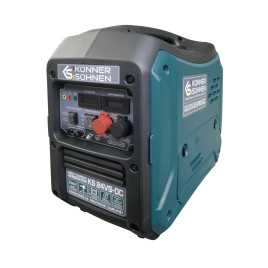
TheKönner & Söhnen KS 24VM-DC is a specialised DC generator designed for charging batteries in 24 V bus systems. This model is not designed as a universal generator for directly powering domestic appliances, but specifically as a backup source for maintaining and charging batteries in systems where the stability of the battery circuit is of key importance. This is precisely why it is well suited for solar power stations, CCTV systems, security complexes, telecommunications equipment, backup automation units, and for maintaining batteries whilst vehicles are parked. :contentReference[oaicite:1]{index=1}
The generator operates in the 24–27 V range, has a rated power of 1.6 kW and delivers a current of up to 60 A. The manual explicitly states that it is designed for charging batteries with a voltage range of 24–27 V, and that the charging cables must have a sufficient cross-section to handle currents of up to 50–60 A. This makes the model a practical solution specifically for DC systems, where it is important to avoid unnecessary energy conversion stages and minimise losses during battery charging. :contentReference[oaicite:2]{index=2}
The KS 24VM-DC operates according to the IUo charging characteristic. In the first stage, the battery is charged with a constant current of 60 ± 3 A until a voltage of 27–27.5 V is reached. After this, the generator switches to constant output voltage mode. If the charging current is lower from the outset, the charger operates immediately at 27–27.5 V. This charging algorithm is well suited to backup systems where it is not simply a matter of supplying power, but of doing so in a more appropriate and stable mode for the battery itself. :contentReference[oaicite:3]{index=3}
One of the main advantages of this model is its automatic operating mode. In AUTO mode, the generator monitors the voltage of the connected battery itself and starts automatically when it drops to 23.5–24 V. After charging to 27–27.5 V and the current falling below 25 A, the generator switches off automatically and enters standby mode. This is precisely what makes it very convenient for systems that need to operate autonomously without constant user intervention. :contentReference[oaicite:4]{index=4}
For more flexible use, a MANUAL/EXTERNAL CONTROL mode is also provided. In this mode, the generator can be started manually or via an external control device operating via dry contacts. This approach allows the unit to be integrated into more complex backup power systems alongside inverters, uninterruptible power supplies, batteries with BMS, time relays, voltage control relays and other automation systems. This significantly expands the generator’s scope of application and enables it to be adapted to the specific requirements of a given facility. :contentReference[oaicite:5]{index=5}
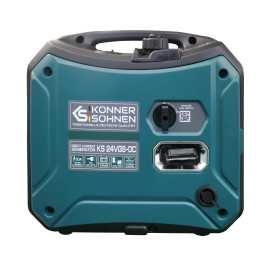
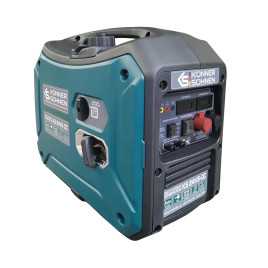
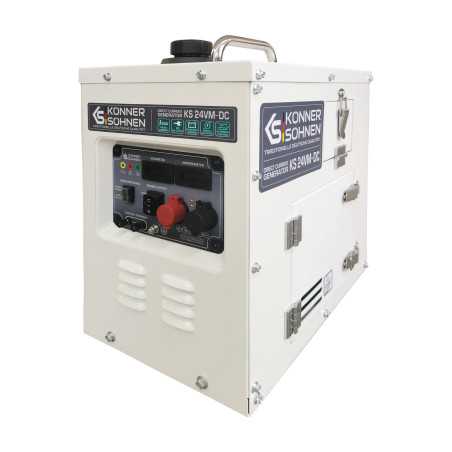
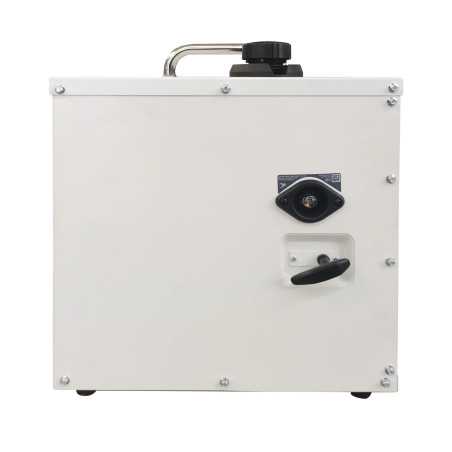
A particular strength of the KS 24VM-DC is its robust, noise-reducing metal casing. It not only reduces noise during operation but also better protects internal components from mechanical impact, dust and accidental external factors. The model has a declared noise level of 62/87 dB, making it significantly more comfortable to use alongside residential, service or work areas where a standard open generator would be less suitable. This design also gives the model a more “technical” and robust build for regular use. :contentReference[oaicite:6]{index=6}
The control panel features a voltmeter, ammeter, voltage indicator, overload indicator and oil level indicator. This allows you to constantly monitor the generator’s key operating parameters and the status of the charging process. The green power indicator flashes or remains lit depending on the current, and the protection system responds to overloads, short circuits and emergency conditions. If the voltage on the 24 V bus or battery reaches 30 V or higher, the generator switches off within 10 seconds. If the output voltage drops below 20 V, the system detects this as a short circuit and immediately stops operation. :contentReference[oaicite:7]{index=7}
The model is equipped with a KS 100i 4-stroke petrol engine with a displacement of 79.7 cm³ and a power output of 2.5 hp. The fuel tank has a capacity of 5 litres, and the oil sump — 0.4 litres. Automotive petrol with an octane rating of 90–95 must be used for operation, and SAE 10W-30 and SAE 10W-40 oils are recommended for engine maintenance. :contentReference[oaicite:8]{index=8}
The generator does not have its own battery and is started from a connected battery, which must be charged. If the battery charge is insufficient, starting is possible using a manual starter. The cable from the generator to the battery must be protected by a 70–80 A fuse. The manual also specifically emphasises that the generator may only be used to charge the battery, and not for directly connecting electrical loads. This is a very important point for correct and safe operation. :contentReference[oaicite:9]{index=9}
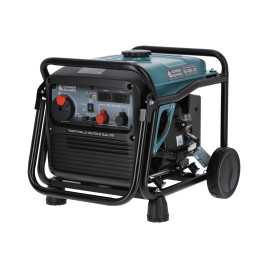
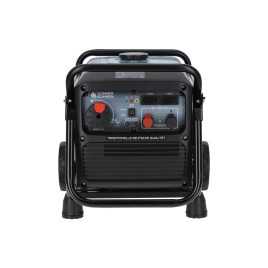
Another interesting advantage of this model is its compatibility with Tandem Power and the ability to operate in tandem with the KS 3000PS. Thanks to this, the generator can form part of a more flexible backup system with energy storage, where automation, charging stability and convenient redundancy are key.
TheKönner & Söhnen KS 24VM-DC is a well-designed solution for those who need not just an ordinary petrol generator, but specifically an efficient 24 V DC charging module with automatic mode, external control, a protected housing and the ability to operate in modern battery systems.
Data sheet
Specific References
A DC power generator for charging 24–27 V batteries in backup power systems, solar power stations, CCTV systems, security solutions and for maintaining battery charge whilst vehicles are parked.
In AUTO mode, it starts automatically when the battery voltage drops, charges the battery and, once the required parameters are reached, switches to standby mode.
It has a rated power of 1.6 kW, a current of up to 60 A, a noise-reducing metal casing, an LED display, an indication of key parameters, and is compatible with Tandem Power technology for operation in tandem with the KS 3000PS.